
One Operator, Five Robots: How Ambi's Data Flywheel Adapts to Your SKU Mix
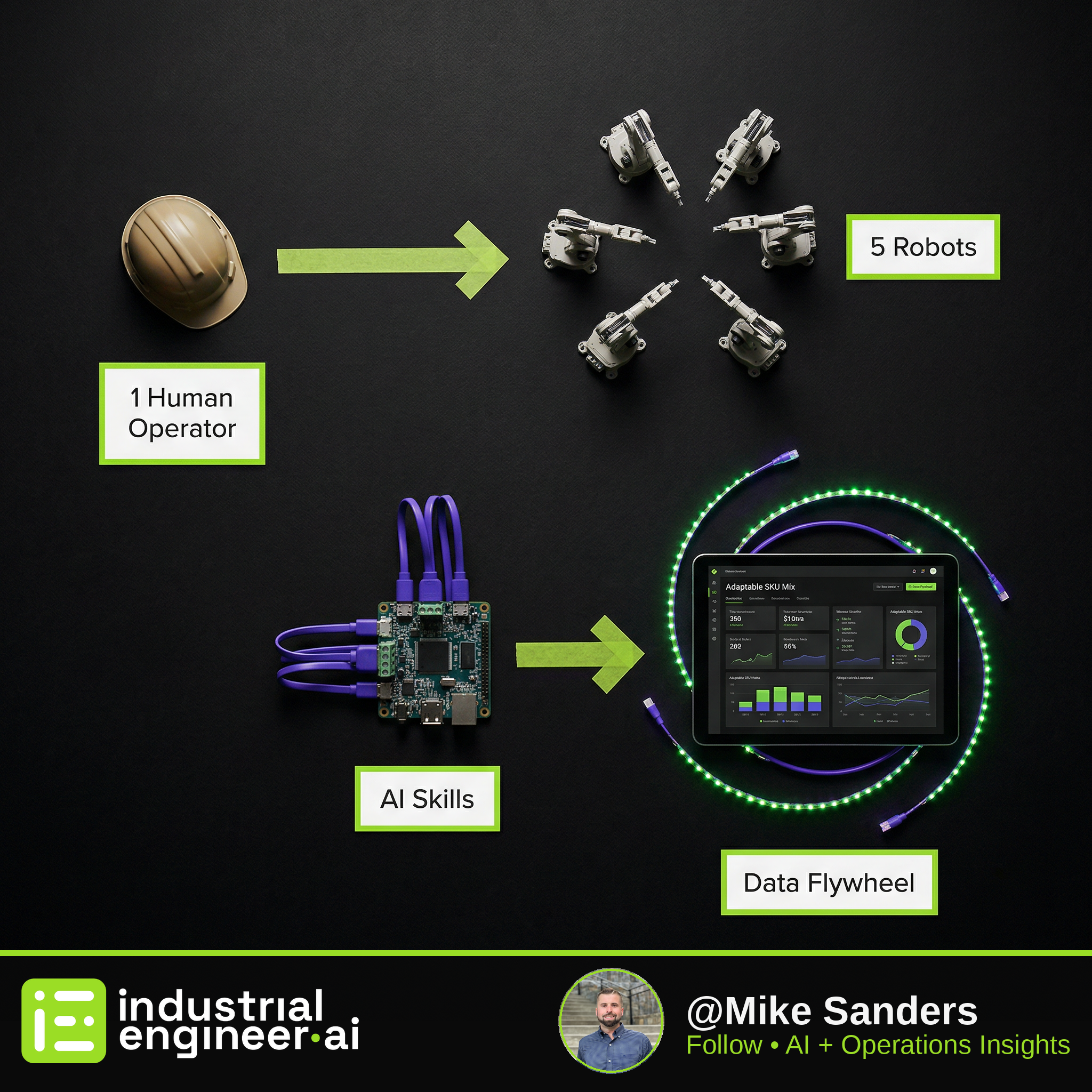
Ambi Robotics turns one human operator into a fleet manager of one to five robots — people who used to sort packages by hand now oversee AI-powered systems that pick, sort, and pack across changing product types. Their AmbiOS platform combines modular AI skills (picking, placing, item analysis, quality control) with swappable hardware, and uses a sim-to-real data flywheel where simulation bootstraps the model, production data refines it through supervised learning, and scale eventually enables unsupervised learning. If you're evaluating warehouse robotics on single-task throughput, you're missing the point — the real question is how fast the system adapts when your SKU mix shifts next quarter.
From the Source
"We usually have people who are formerly sorting packages by hand becoming robot operators and managing one to maybe five robots in a production environment to get a productivity increase."
— EP 613: Reinventing Warehouse Stacking with Ambi Robotics
Our Take
This confirms what we see across every industry we work in: the highest-ROI automation isn't about replacing people — it's about redesigning the human role from task executor to system operator, multiplying throughput per person while building an adaptable platform that compounds in value as your data grows.
Key Takeaways
- 01Ambi Robotics' deployment model converts manual sorters into robot operators managing 1-5 machines each — a direct labor multiplier that redefines the staffing equation for 3PL and warehouse operations
- 02Their AmbiOS platform combines a growing library of modular AI skills (picking, placing, item analysis, quality control) with swappable hardware components (arms, cameras, end effectors), so one platform reconfigures for different tasks without full redeployment
- 03The AI training follows a three-phase data flywheel: start in simulation to bootstrap the model, deploy robots to collect supervised production data, then scale into unsupervised learning as data volume grows — each phase compounding model performance
- 04Transfer learning is the strategic unlock — skills learned picking packages can transfer to picking apparel or other item types, meaning your robotics investment doesn't depreciate when your product mix changes
- 05The platform handles real-world edge cases like items in bin corners, on conveyor edges, damaged goods, or stuck-together items — the kind of variability that breaks single-task automation
Watch the Source
EP 613: Reinventing Warehouse Stacking with Ambi Robotics
Source
EP 613: Reinventing Warehouse Stacking with Ambi Robotics
Video embedded above — watch without leaving the site
Extracted and verified via Adversarial AI Pipeline
Get the IE.AI Weekly Brief
Top 3 AI-distilled industrial engineering insights, every Sunday. No fluff.
No spam. Unsubscribe anytime with one click.