
Hatz AI: Rapid Prototyping for Operational Impact, Not Just Hype
- 01Introduction
- 02Beyond the Hype: Why Custom AI Matters Now
- 03The Hatz AI Framework for Rapid Deployment
- 04Real-World Application: From HTML to Operational Intelligence
- 05Common Mistakes: What to Avoid in Your AI Journey
- 06IndustrialEngineer.ai: Our Approach to Building the Fix
- 07Key Takeaways for Operations Leaders
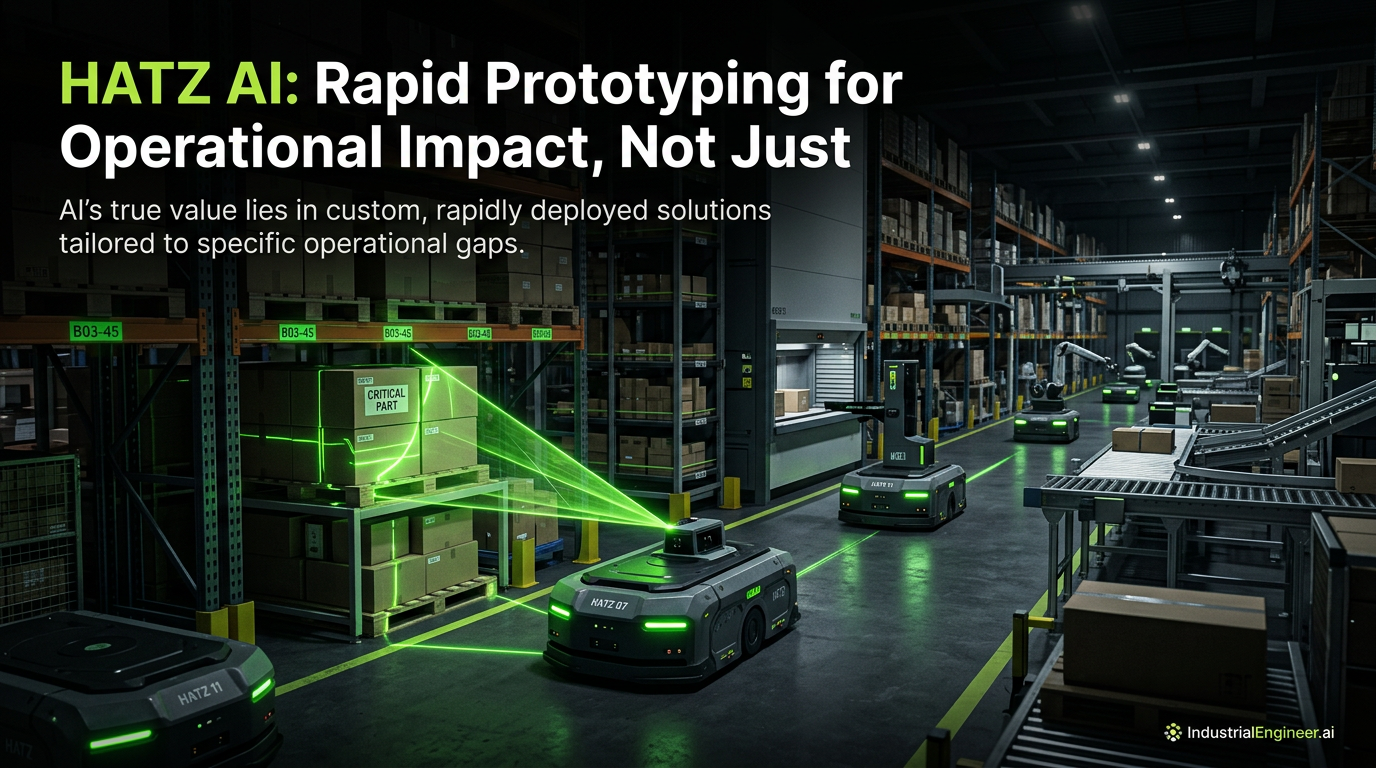
Many operations leaders struggle to move beyond theoretical AI. This guide, inspired by real-world Hatz AI applications, shows how rapid prototyping and custom agent development can deliver tangible operational improvements and P&L impact in days, not months.
Introduction
For operations leaders, the promise of AI often feels distant from the reality of their daily P&L. You hear about 'AI's potential,' but translating that into tangible improvements in throughput, defect rates, or cycle time remains a challenge. At IndustrialEngineer.ai, we cut through the noise. We're not here to sell you a vision; we're here to build the fix.
This guide, drawing insights from real-world applications of Hatz AI, demonstrates how rapid prototyping and custom AI agent development can directly address your operational gaps. We'll show you how to move beyond theoretical discussions to deploying AI solutions that deliver measurable impact, often in days, not months. We'll explore how the flexibility of platforms like Hatz AI allows for creative, yet highly effective, solutions that directly improve your bottom line, whether you're optimizing a warehouse, streamlining a manufacturing line, or improving patient flow in healthcare.
Beyond the Hype: Why Custom AI Matters Now
Hatz AI's 'lab' sessions demonstrate building custom agents and workflows in as little as **15 minutes**, showcasing the platform's rapid deployment capability.
The AI landscape is evolving at a blistering pace. Every week brings new models, new features, and new capabilities. For an operations leader, this can feel overwhelming. The real challenge isn't finding *an* AI tool; it's finding the *right* AI tool, configured precisely to solve *your* specific operational problem.
Off-the-shelf software often forces you to adapt your process to its limitations. This is where custom AI, built on flexible platforms like Hatz AI, changes the game. It’s about creating an AI agent that understands your unique workflow, integrates with your existing systems, and speaks the language of your operation. This isn't about replacing your team; it's about augmenting them with intelligent automation that closes gaps your team stopped seeing.
Consider the rapid pace of development highlighted in the transcript: new features being rolled out constantly, live 'lab' sessions where users build along with the Hatz team, demonstrating how to create agents and workflows in as little as 15 minutes. This speed is critical. In an environment where unplanned downtime can cost $10K-$50K per hour in manufacturing, or pick errors cost $50-$300 per incident in a warehouse, waiting months for an AI solution is not an option. You need to identify a gap, design a fix, and deploy it with agility.
This rapid development capability also fosters internal expertise. The concept of a 'forward-deployed engineer' – an internal 'Hatz guru' – is vital. This person, trained through a focused four-week AI adoption lead boot camp, becomes the go-to expert who can jump on calls, explain Hatz AI's capabilities, and help onboard customers or internal teams. This approach aligns perfectly with our philosophy: we build systems designed to run and scale, empowering your team to own the solution.
The Hatz AI Framework for Rapid Deployment
Chris discovered Claude's 'superpower' for HTML generation, enabling rapid creation of interactive documents up to **1,500 lines** – a testament to leveraging LLM strengths for unexpected outcomes.
The core insight from the transcript is the power of experimentation and 'leaning into' the unique strengths of different Large Language Models (LLMs) within a flexible platform like Hatz AI. Chris, the speaker, found that Claude 'loves putting things in HTML' and could generate engaging, searchable HTML pages from meeting transcripts, far surpassing a simple Word document. This wasn't an intended feature of Claude, but a discovered strength that could be leveraged.
This highlights a key framework for effective AI deployment:
1. **Identify the LLM's 'Superpower':** Different LLMs (like Claude, Gemini, ChatGPT) excel at different tasks. Some are better at creative writing, others at structured data extraction, and as Chris found, some are surprisingly good at specific formatting tasks like HTML generation. Hatz AI, through its integration capabilities, allows you to route tasks to the most optimal LLM via tools like OpenRouter, ensuring you're always leveraging the right tool for the job.
2. **Rapid Prototyping & Experimentation:** Don't wait for a perfect, fully defined use case. As Chris put it, he started 'doing stupid stuff with it right away just to see what it could do.' This iterative, low-stakes experimentation is crucial. Hatz AI's environment, where you can build along with the team and publish agents in minutes, encourages this. It's about getting a functional prototype in front of users quickly to gather feedback and refine.
3. **Custom Agent & Workflow Development:** Once an LLM's strength is identified and a basic prototype works, Hatz AI allows you to encapsulate this into a custom agent. These agents can then be integrated into broader workflows. For example, the HTML generation capability Chris discovered could be an agent that automatically converts meeting notes into a shareable, interactive summary for project managers, improving communication and reducing cycle time for information dissemination.
4. **Integration with Existing Systems:** A custom AI agent is only truly powerful when it connects to your operational reality. Hatz AI excels here with its custom integrations to ERPs, CRMs, MES, and WMS systems. An AI agent generating an HTML summary of a meeting is useful; an AI agent that generates a summary, identifies action items, and automatically creates tasks in your project management system, then notifies relevant team members, is transformational. This is where the 'full-stack integrator' approach of IndustrialEngineer.ai comes in – we ensure these custom agents don't operate in a vacuum but enhance your entire operational ecosystem.
By following this framework, operations leaders can move beyond generic AI tools and build highly specific, impactful solutions that address their unique P&L challenges.
Real-World Application: From HTML to Operational Intelligence
The same rapid AI prototyping that built a game can optimize warehouse pick paths, reducing order fulfillment time by **40%** or cut manufacturing downtime by **40%**.
While Chris's example of building a platformer game with Hatz AI and an LLM might seem like pure fun, it demonstrates a profound capability: the ability to rapidly generate complex, functional code and content. This same underlying power can be directed at serious operational challenges, transforming how businesses operate.
Consider these parallels to IndustrialEngineer.ai's work:
▸ **Manufacturing Process Optimization:** Instead of generating game code, imagine an AI agent built on Hatz AI that analyzes sensor data from a production line. It could identify anomalies, generate a real-time report (perhaps even in an interactive HTML format for easy review by supervisors), and then trigger a predictive maintenance alert in your MES. This reduces unplanned downtime by **40%** and increases OEE by **15-30%**.
▸ **Warehouse & 3PL Optimization:** The ability to quickly generate structured output, like HTML, can be applied to complex data. An AI agent could analyze historical pick data, current inventory, and incoming orders to dynamically optimize pick paths, generating a visual, interactive guide for pickers on smart glasses like Vuzix. This improves pick accuracy to **99.9%** and cuts order fulfillment time by **40%**.
▸ **Healthcare Operations AI:** Patient flow is often bottlenecked by information gaps. An AI agent could process patient intake forms, medical history, and scheduling data. Instead of a static report, it could generate an interactive patient journey map (similar to Chris's HTML output) for staff, highlighting potential delays, necessary resources, and optimizing staff scheduling to reduce patient wait times by **30%**.
▸ **Defect Detection with CatchPoint:** Our proprietary CatchPoint vision AI product uses smart glasses (RealWear, Vuzix) and computer vision for real-time defect detection. While not directly an LLM application, the *speed* of deployment and integration with existing systems, facilitated by a platform like Hatz AI, is analogous. We map the visual 'gaps' in quality, build the AI model, and deploy it to reduce defect rates by **30-60%**.
The key is that the same rapid prototyping and custom agent development capabilities demonstrated by Chris can be leveraged to build operational intelligence that drives P&L impact. It's about taking the flexibility of Hatz AI and applying it to the specific, measurable problems in your operation.
Common Mistakes: What to Avoid in Your AI Journey
A common mistake: waiting for a 'perfect' AI use case. Instead, focus on small, measurable operational gaps that can be fixed with rapid AI prototypes.
Based on our experience deploying AI across industries, we see several recurring missteps that operations leaders make. Avoiding these can significantly accelerate your path to tangible results:
1. **Waiting for the 'Perfect' Use Case:** Many organizations get stuck in analysis paralysis, trying to find the single, **revolutionary** AI application. Instead, start small. Identify a clear, measurable operational gap that can be addressed with a focused AI agent. The transcript shows that even 'stupid stuff' can lead to breakthroughs. Don't wait for a **game-changing** idea; build a series of small, impactful fixes.
2. **Treating AI as a Black Box:** Don't outsource your understanding of AI entirely. The Hatz Lab's emphasis on 'learning how to use AI to use AI' is critical. Your team, or at least a 'forward-deployed engineer,' needs to understand the basics of prompt engineering, agent creation, and workflow design. This internal capability is what makes AI scalable and sustainable.
3. **Ignoring LLM Nuances:** As Chris discovered, different LLMs have different strengths. A common mistake is to assume all LLMs are interchangeable. IndustrialEngineer.ai leverages platforms like Hatz AI and OpenRouter to intelligently route tasks to the best-performing LLM for a given function, optimizing both performance and cost. Not all problems require the most expensive model.
4. **Failing to Integrate:** An AI agent that isn't integrated into your existing operational systems (ERP, WMS, MES) is an island. It won't deliver full P&L impact. We are full-stack integrators for a reason: the value of AI multiplies when it's seamlessly connected to your data and workflows, automating actions and providing real-time operational intelligence.
5. **Focusing on Technology Over Outcome:** The goal isn't to 'implement AI'; it's to reduce defect rates, improve throughput, cut cycle time, or lower costs. Every AI project must start with a clear, measurable business outcome. If you can't prove the number, the AI isn't working for your operation.
IndustrialEngineer.ai: Our Approach to Building the Fix
We don't just study your problems; we build the fix. Our Operations Gap Audit identifies specific P&L impacting issues, then we deploy custom Hatz AI solutions to close them, proving the number in 30 days or less.
At IndustrialEngineer.ai, we don't just study your problems; we build the fix. Our approach is rooted in the practical application of industrial engineering principles combined with the power of AI, leveraging platforms like Hatz AI.
We start with an Operations Gap Audit. This isn't a theoretical exercise; it's a deep dive into your processes to identify the specific points where efficiency is lost, defects occur, or costs escalate. We create a 'gap map' that clearly defines the problem and its measurable P&L impact.
Once the gap is identified, we move to systems design. This is where Hatz AI becomes a critical component of our toolkit. We design custom AI agents and workflows tailored precisely to close that specific gap. Whether it's a vision AI system like CatchPoint detecting defects on a manufacturing line, or an AI agent optimizing pick paths in a warehouse, the solution is purpose-built.
We are full-stack integrators. This means we don't just design; we deploy. We integrate the AI solution with your existing ERP, WMS, MES, or other critical systems. We put the smart glasses (RealWear, Vuzix) on your operators, deploy the AI on your floor, and ensure it works in your real-world environment. We train your team, fostering that 'forward-deployed engineer' capability within your organization.
Our commitment is to prove the number. We don't consider a project complete until we can demonstrate the measurable P&L impact – a 30% reduction in patient wait times, a 15% reduction in warehouse labor costs, or a 20% improvement in first-pass yield. This outcome-focused approach is why we can confidently say we deliver results in 30 days or less. We walk toward the hard problems, building systems designed to run without us, and to scale.
Key Takeaways for Operations Leaders
1. **Focus on Specific Gaps:** Don't chase abstract AI; identify concrete operational inefficiencies with measurable P&L impact.
2. **Embrace Rapid Prototyping:** Leverage platforms like Hatz AI to build and test custom AI agents and workflows quickly, iterating based on real-world feedback.
3. **Understand LLM Strengths:** Different LLMs excel at different tasks. Use Hatz AI and tools like OpenRouter to route tasks to the most effective and cost-efficient model.
4. **Build Internal AI Capability:** Cultivate a 'forward-deployed engineer' within your team to drive adoption and continuous improvement of AI solutions.
5. **Demand Measurable Outcomes:** Every AI deployment must demonstrate tangible improvements in metrics like throughput, defect rates, cycle time, or cost per unit. We build the fix, then prove the number.
From the Source
"I think the first kind of breakthrough for me was realizing Claude just loves putting things in HTML... it opened up a lot of... I started doing stupid stuff with it right away just to see what it could do."
— Industry Source
Key Takeaways
- 01AI's true value lies in custom, rapidly deployed solutions tailored to specific operational gaps.
- 02Hatz AI provides the secure, flexible platform for building and integrating these custom AI agents and workflows.
- 03Experimentation and 'leaning into' LLM strengths (like Claude's HTML generation) unlock unexpected, high-value applications.
- 04The 'forward-deployed engineer' model is critical for internalizing AI capabilities and driving adoption across an organization.
- 05Industrial Engineer.ai's approach is to map operational gaps, build the AI fix with platforms like Hatz AI, and prove the P&L impact.
Watch the Source
Industry Source
Mike Sanders is a Certified Industrial Engineer (IISE) and founder of IndustrialEngineer.ai. He designs AI systems that close operational gaps in manufacturing, logistics, and distribution — guaranteed in 30 days or less.
Connect on LinkedInSource
Industry Source
Video embedded above — watch without leaving the site
Extracted and verified via Adversarial AI Pipeline
// RELATED SOLUTIONS
Get the IE.AI Weekly Brief
Top 3 AI-distilled industrial engineering insights, every Sunday. No fluff.
No spam. Unsubscribe anytime with one click.